

The Caribbean in September has a bad reputation. It's partly deserved: it's the peak of hurricane season, prices drop because demand drops, and many hotels take advantage of the time to close for maintenance.
But that narrative makes a serious mistake: it treats five very different islands as if they were the same. Aruba and Curacao lie outside the main hurricane belt. Jamaica and Dominican Republic are right in the center. Puerto Rico occupies a middle point, with infrastructure that has improved since Maria, though it remains exposed. Ignoring these differences doesn't just affect your wallet. It can make you lose your entire trip.
This analysis gives you real budgets by traveler profile, shows you the windows where you can save between 20% and 50%, and explains exactly what climate risk you're taking on each month.
Why hurricane risk isn't the same on all islands
🔗 Recommended · EKTA InsuranceThe official hurricane season runs from June 1 to November 30, with the peak between mid-August and mid-October. That doesn't mean the entire Caribbean has the same danger.
Meteorologists talk about the "hurricane belt," a strip between 10° and 25° north latitude. The ABC islands (Aruba, Bonaire and Curacao) are between 12° and 13° north, hugging Venezuela's coast. According to historical records from the National Hurricane Center, Aruba and Curacao have been hit by category 1 or higher hurricanes fewer than five times in the past hundred years.
Jamaica, Dominican Republic and Puerto Rico are between 17° and 21° north, right in the hot zone. The probability of direct impact or severe conditions during September or October is statistically relevant.
The practical rule is simple. If you're looking for savings without risking your trip to weather, Aruba and Curacao are the smart choice. If you can travel in May, June or November, all five destinations are reasonable. If you insist on Jamaica or Dominican Republic in September, insurance with weather cancellation coverage isn't optional.
The low season windows that actually matter
Within the months of June to November, not all weeks offer the same price-risk ratio. There are four windows worth distinguishing.
Early June (June 1-15): Prices already drop from Easter and May peaks, but hurricane risk remains low. It's the window with the best balance of the year. Flights from Mexico and Colombia are usually between 20% and 30% cheaper than in December or January.
July and August: Low prices on flights and hotels, but heat and humidity at their highest point. Cyclonic activity exists, though the peak hasn't arrived yet. It's the mandatory window for families with school-age children. It works well if you choose your destination carefully.
September and October: Real hurricane peak. Prices hit bottom. Hotels in Dominican Republic and Jamaica can be between 40% and 50% cheaper than in January. This window only makes sense in Aruba or Curacao, or if you have total flexibility to change dates without losing money.
November: The comeback window. After November 15th risk drops dramatically, prices haven't yet risen to high season and weather stabilizes. It's the second-best option of the year, after early June.
Dominican Republic: the destination with the widest price range
Dominican Republic has the largest price spread between high and low season. That makes it the most interesting destination for tight budgets, as long as you know how to choose your dates.
Punta Cana concentrates the all-inclusive resorts. A mid-level resort in January or February costs, according to our estimates, between $180 and $280 USD per person per night all-inclusive. The same resort in June drops to between $100 and $160 USD, and in September can be between $80 and $120 USD.
For a mid-budget traveler on seven nights:
- High season (January-March): According to our estimates, between $1,800 and $2,500 USD per person including flight from Mexico or Colombia, accommodation and additional expenses.
- Low season (June): According to our estimates, between $1,100 and $1,600 USD per person. The savings exceed 30%.
- Extreme low season (September): According to our estimates, between $800 and $1,200 USD per person, but with real hurricane risk. Check the hotel and airline cancellation policies before paying.
The all-inclusive format has a clear advantage in low season: even though the hotel is at 40% occupancy, services usually remain complete. You pay less for practically the same experience, just with fewer people at the pool and beach.
Puerto Rico: the island that plays in another league
Puerto Rico is U.S. territory. That changes the equation completely. Prices are more like Miami than Santo Domingo. There's no currency control or special tariffs. It's convenient if you're traveling from the United States: domestic flight, no passport needed. It's more expensive if you're coming from Latin America.
A mid-level hotel in Condado or Miramar costs, according to our estimates, between $150 and $250 USD per night in high season and between $90 and $160 USD in low season. All-inclusive isn't the dominant format. Most are boutique hotels, so you need to budget food separately.
For a mid-budget traveler on seven nights from Mexico or Colombia:
- High season (December-April): According to our estimates, between $1,600 and $2,400 USD per person including flight, accommodation and food.
- Low season (June-July): According to our estimates, between $1,100 and $1,700 USD per person.
Hurricane risk is real. Maria in 2017 made the impact clear. Infrastructure has improved, but for September and October, insurance with weather coverage remains mandatory.
Aruba and Curacao: the case for risk-free low season
If fear of hurricanes has kept you away from the Caribbean in July, August or September, Aruba and Curacao almost completely eliminate that problem. Their climate record during hurricane season is among the most stable in the region.
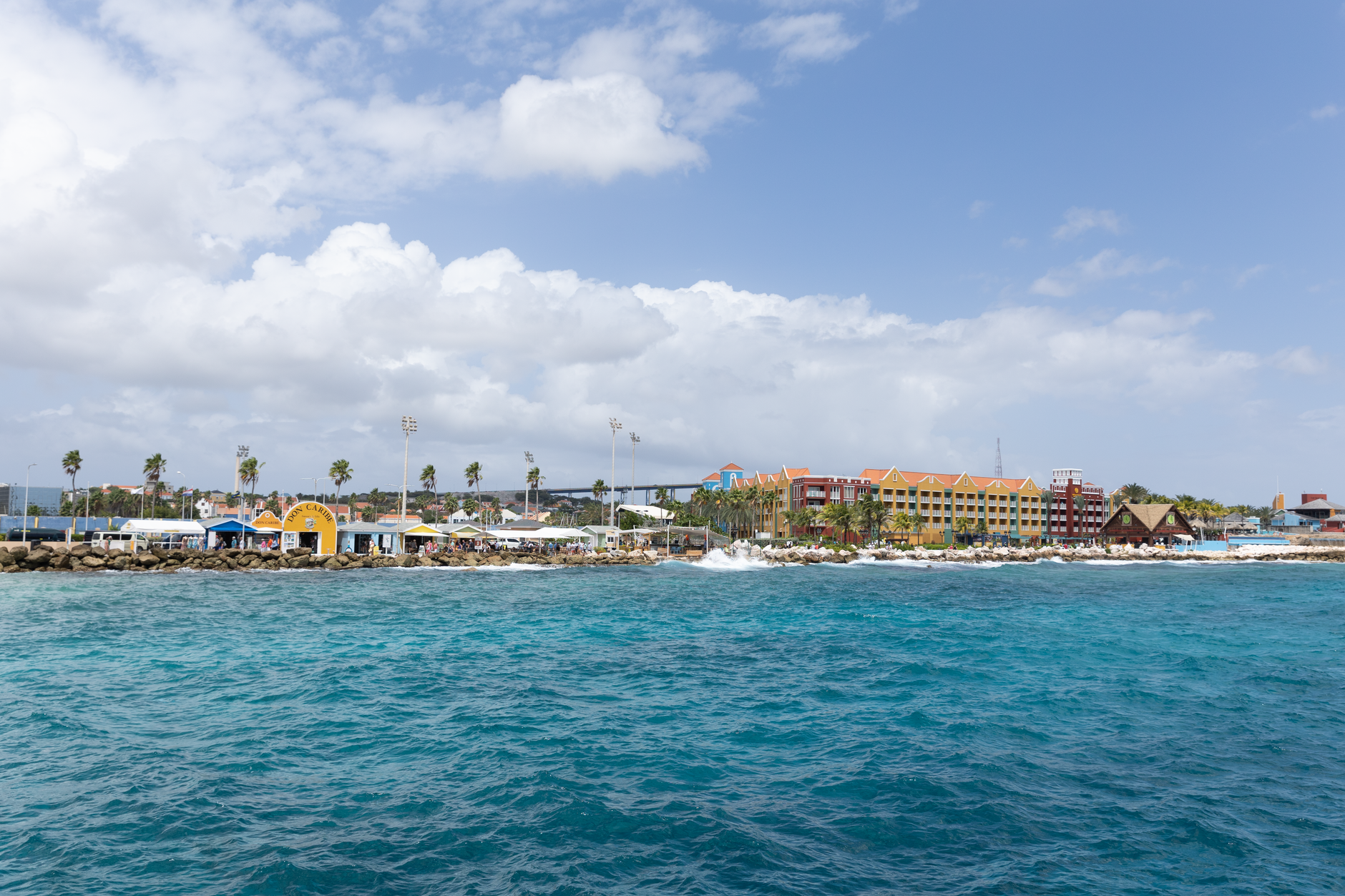
The difference between them is character. Aruba is oriented toward resorts and beaches like Eagle Beach. Curacao offers a more local experience: the Dutch architecture of Willemstad —a World Heritage Site— and a world-class diving scene.
Cost-wise, both islands are more expensive than Dominican Republic or Jamaica at any time. A mid-level hotel in Aruba costs, according to our estimates, between $200 and $350 USD per night in high season. In low season it drops to between $140 and $220 USD. The percentage savings is lower because demand doesn't drop as much: informed travelers precisely choose them during these months.
For a mid-budget traveler on seven nights:
- High season (December-April): According to our estimates, between $2,200 and $3,200 USD per person.
- Low season (July-September): According to our estimates, between $1,600 and $2,400 USD per person.
Curacao is usually between 10% and 20% more accessible than Aruba in the same category, with the additional advantage of better direct air connections from several South American cities.
Jamaica: the destination with the highest reward for the informed traveler
Jamaica has something the other four destinations don't offer to the same extent: a local culture that you can feel outside the resorts. Negril, Ocho Rios and Kingston let you go from luxury all-inclusive to local accommodation at $25 USD per night steps from the sea. That variety makes it the destination with the greatest potential for real savings if you know how to move around.
The problem is that it's also right in the hurricane zone. The correct strategy is to travel in June or November, never in September.
For a low-to-mid budget traveler on seven nights:
- High season (December-April): According to our estimates, between $1,400 and $2,000 USD per person including flight from Mexico, guesthouse or mid-level hotel accommodation and local food.
- Low season (June): According to our estimates, between $900 and $1,400 USD per person. Flights to Montego Bay can drop between 25% and 35% compared to January.
Jamaica is the only one of the five where traveling independently, without all-inclusive, makes clear economic sense. The density of local food and accommodation options makes it viable and attractive.

The decision table: five destinations, three profiles, two seasons
To make the comparison direct, here are the estimated total budget ranges for seven nights per person, including flight from Mexico or Colombia, mid-level accommodation and basic expenses:
| Destination | Profile | High season | Low season | Estimated savings | Hurricane risk (Sep) |
|---|---|---|---|---|---|
| Dominican Republic | Mid | $1,800-$2,500 | $1,100-$1,600 | 30-38% | High |
| Puerto Rico | Mid | $1,600-$2,400 | $1,100-$1,700 | 25-31% | Mid-high |
| Aruba | Mid-high | $2,200-$3,200 | $1,600-$2,400 | 25-27% | Very low |
| Curacao | Mid | $1,900-$2,800 | $1,400-$2,100 | 25-26% | Very low |
| Jamaica | Low-mid | $1,400-$2,000 | $900-$1,400 | 30-36% | High |
All ranges are estimates and should be verified at the time of your search. Flight prices vary according to exact origin, advance booking and airline.
Travel insurance isn't optional in the Caribbean during low season
If you're going to Dominican Republic, Jamaica or Puerto Rico between July and October, you need insurance that explicitly includes cancellation or interruption due to weather phenomena. Not all plans include this by default.
Our comparative analysis of SafetyWing, World Nomads and AXA for Latin American travelers showed important differences in these coverages. Read it before contracting.
The cost of insurance, according to our estimates, is between $40 and $120 USD per person for a week. It's the expense most often omitted when calculating the budget and most regretted afterward.
The verdict with numbers
Low season in the Caribbean isn't a uniform block. It's a series of decisions that depend on three concrete variables: your tolerance for climate risk, your available travel window and your spending profile.
If you have total flexibility, June and November are the windows with the best price-risk ratio for all five destinations. If you can only travel in July, August or September, Aruba and Curacao are the only options where savings don't come with real risk of losing your trip. If your budget is the main factor and you can go in June, Jamaica and Dominican Republic offer the greatest absolute savings.
What doesn't make sense, with any profile or budget, is going to Jamaica or Dominican Republic in September without travel insurance and without flexible cancellation policy. The $400 USD savings on accommodation doesn't compensate for the risk of losing $1,500 USD in non-refundable flights and reservations.
The best trip isn't the most expensive or the cheapest — it's the best reasoned.
Ready to plan your Caribbean trip with real numbers? Talk to Osi on Telegram and we'll help you build the budget for your route, with your origin, your dates and your profile.
Sources
- National Hurricane Center — Historical Hurricane Tracks: nhc.noaa.gov
- The Plan — SafetyWing vs World Nomads vs AXA: which one works according to your country (2026)
- The Plan — Price and season analysis in the Caribbean (2026)