

The mistake of budgeting Colombia as an average
🔗 Recommended · AviasalesWhen someone asks me how much Colombia costs, I tell them the question is wrong.
Colombia doesn't have one price. It has three. Bogota and Medellin move within fairly predictable ranges, whether you're backpacking or traveling with more comfort. Cartagena is a different world: there you're not competing against the average Colombian salary, but against cruise ships that drop off thousands of passengers with dollars in their pockets, and destination weddings that inflate prices to levels you don't see anywhere else in the country.
That's why a flat budget for "eight days in Colombia" usually fails. Either you arrive in Cartagena short on cash, or you waste money in Bogota that you could have used better on the Rosario Islands or a good Comuna 13 tour.
The route I'm proposing — two days in Bogota, three in Medellin and three in Cartagena — is designed exactly for that. It gives you more time where your money stretches further and clearly warns you which days will hurt your wallet the most. Every number you'll see here is labeled: I tell you which ones are reasoned estimates and which come from direct sources. That way you decide how much buffer to add to your real budget.
The 2-3-3 route: why this order and not another
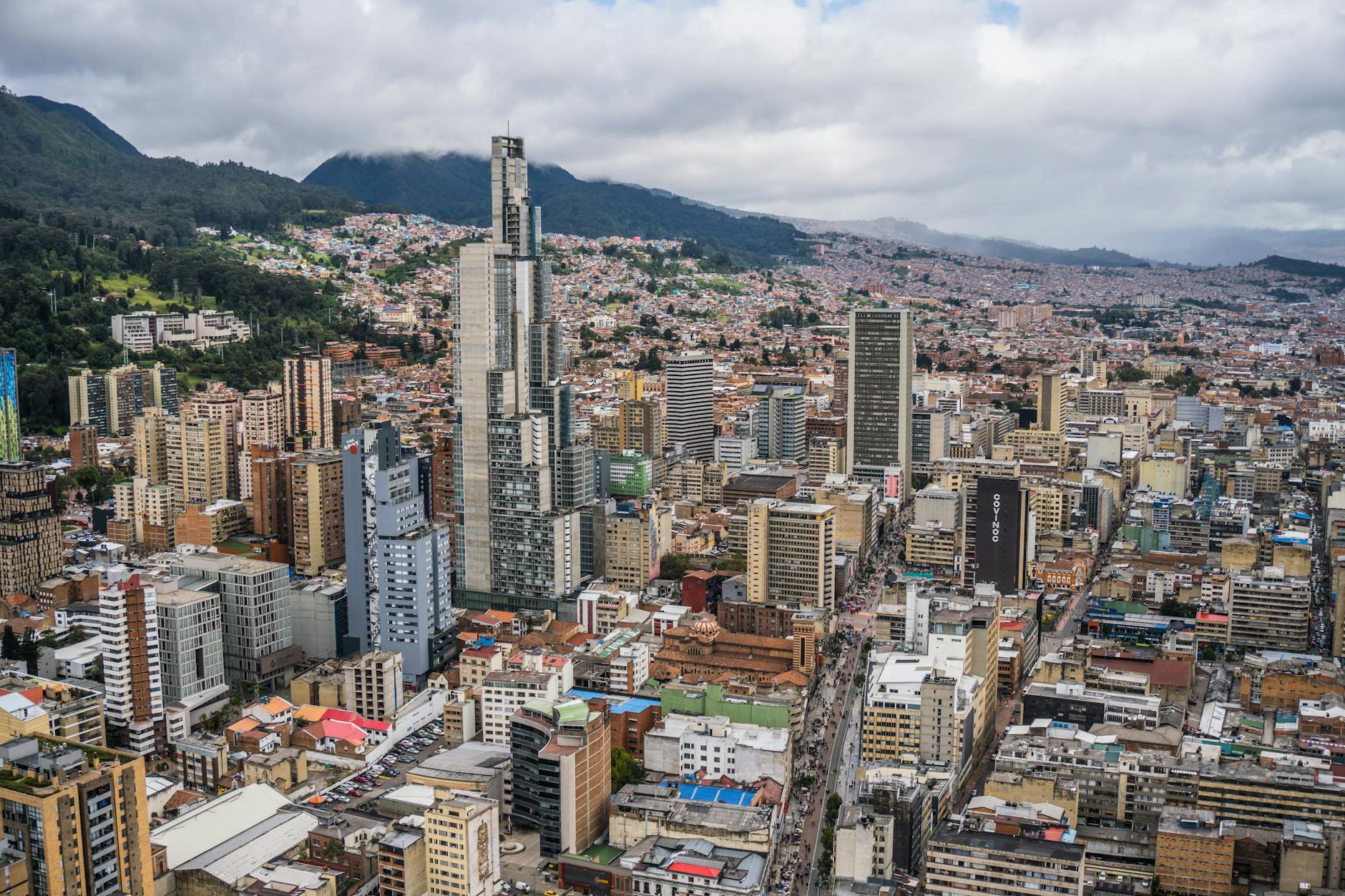
Bogota, with two days, is usually your mandatory entry point if you're coming from Mexico, the United States, or the rest of Latin America. Two full days are enough to explore La Candelaria at a relaxed pace, visit the Gold Museum, go up to Monserrate, and take a walk around Zona Rosa or Chapinero. Staying longer only makes sense if you're especially interested in its fine-dining scene or its less touristy museums.
Medellin, with three days, is where low cost, perfect year-round weather, and plenty to do combine best. A full day in Comuna 13 to understand its transformation story through graffiti and escalators, another full day in Guatape — including the climb up Piedra del Penol — and a day to enjoy downtown, Pueblito Paisa, and the nightlife of El Poblado or Laureles more than justify the extra night.
Cartagena, with three days, is where almost every itinerary goes wrong. Fitting in only two days is a mistake. You need three: the walled city is best enjoyed slowly, walking along the walls at sunset, wandering through Getsemani without rushing, and dedicating a full day to the Rosario Islands if you want snorkeling and beach time without hurrying.
The order follows flight logic. You enter and exit through El Dorado in Bogota, which has the best international connections. The domestic hops Bogota-Medellin and Medellin-Cartagena are cheap and frequent. It's a clean route, with no unnecessary backtracking that would waste half a day.
Domestic flight vs. overnight bus: the calculation no one shows you in full
This is the decision that most affects your trip in time, money, and energy, and very few people do the full math.
The overnight bus sounds logical because "you save a night of hotel." The problem is Colombian geography: mountain roads full of curves, possible landslides, and the accumulated fatigue that wipes out your entire next day.
| Route | Domestic flight (low-cost) | Overnight bus | Useful hours gained |
|---|---|---|---|
| Bogota – Medellin | 1 hour flight + 1.5h airport | 9-10 hours | 8-10 hours |
| Medellin – Cartagena | 1h 15min flight + 1.5h airport | 12-14 hours | 10-12 hours |
The flight gives you back between eight and twelve useful hours per leg. On a trip of only eight days, those hours are gold: you'd rather spend them walking around your destination city than recovering from an overnight bus ride.
In terms of price, low-cost flights (Wingo, EasyFly, or Avianca's basic fares) bought three or four weeks in advance run between 40 and 90 USD per leg (based on our estimates, check the current price with the airline). The bus costs between 25 and 40 USD, but once you factor in the fatigue of the following day and the safety factor of mountain roads at night, the twenty-to-thirty-dollar difference doesn't pay off.
My recommendation is clear: fly the domestic legs. Colombia isn't Europe with high-speed trains. Here, the domestic flight is, in most cases, the smartest choice in terms of time, money, and safety.

Accommodation: what changes between cities
This is where the difference between Cartagena and the rest of the country really shows.
In Bogota and Medellin you can find a decent hostel in a safe area for 15-25 USD a night in a shared dorm, and a decent mid-range hotel between 40 and 70 USD (based on our estimates, check Booking or Despegar). In Cartagena, that same mid-range hotel, inside or very close to the walled city, easily jumps to 90-150 USD per night. During high season or holiday weekends it can go over 200 USD (based on our estimates).
The culprits are cruise ships, destination weddings, and the limited hotel supply inside the walls, which are a UNESCO World Heritage site. If you stay in Getsemani or Bocagrande you can cut costs by 20 to 30 percent without losing practical location. In Medellin, Laureles gives you better value for money than El Poblado without sacrificing safety.
Food and local transport: the invisible daily expense
Budgets break down here, not on flights.
In Bogota and Medellin, a full set lunch — soup, main course, juice, and dessert — costs between 4 and 7 USD. Eating three times a day combining markets and mid-range restaurants leaves a daily food spend of 20-30 USD (based on our estimates). In Cartagena, that same day easily rises to 30-50 USD, especially if you eat near the walled city or in tourist areas.
Transport changes too. In Bogota and Medellin you use TransMilenio or the Metro for less than 1 USD per ride. In Cartagena you walk a lot in the historic center, but when you need to move around you end up relying more on taxis or apps like Uber or InDriver, which can easily add up to 8-15 USD a day (based on our estimates). Planning walking routes through the walled city and Getsemani helps control this expense.
Safe areas by city: a practical, not alarmist, guide
Colombia has improved enormously over the last ten years. The main tourist areas are safe if you use common sense and avoid flashing valuables.
In Bogota, La Candelaria is fine during the day. For sleeping and going out at night, Zona Rosa or Chapinero Alto are better choices. Avoid walking alone downtown after nine or ten at night. Petty theft is the main risk, not violence.
In Medellin, El Poblado is the most touristy and safest area, though also the most expensive. Laureles offers better value for money, a more local vibe, and is also safe to walk around at night. Avoid the area near the downtown metro station after a certain hour.
In Cartagena, the walled city and Getsemani are safe at night as long as you stay in well-lit areas with people around. Avoid the edges of Getsemani toward Avenida Venezuela after eleven at night, and use ride-hailing apps if you venture outside the main circuit. Pickpockets are more active in very crowded areas.
Total budget: 3 real scenarios
Breakdown for eight days and seven nights, not including your international arrival and departure flight.
| Category | Budget | Mid-range | Luxury |
|---|---|---|---|
| Accommodation (7 nights) | 150-180 USD | 400-500 USD | 900-1200 USD |
| Domestic flights (2 legs) | 90-130 USD | 130-180 USD | 180-250 USD |
| Food (8 days) | 180-220 USD | 280-350 USD | 500-650 USD |
| Local transport | 40-60 USD | 70-100 USD | 150-200 USD |
| Activities and entrance fees | 60-90 USD | 120-180 USD | 250-350 USD |
| Approximate total | 520-680 USD | 1000-1310 USD | 1980-2650 USD |
All figures in this table are estimates built from the ranges mentioned above (based on our estimates). Check flight and hotel prices for your exact dates. High season (December-January and Holy Week) can push these numbers up by 20 to 40 percent, especially in Cartagena. El Colombiano's 2026 article on tourism revenue of 5.619 billion dollars clearly explains why Cartagena rises faster than the rest of the country.
Budget by origin: Mexico, Latin America, and the United States
The factor that most affects your total cost is how you get there.
From Mexico, Volaris and Avianca have direct routes to Bogota. Prices vary a lot depending on the season; check directly at volaris.com for your dates. From the rest of Latin America — Peru, Argentina, Chile — Avianca and LATAM usually have good frequencies, but the price depends on your departure city and whether you travel in low season.
From the United States (Miami, Houston, New York) there are many direct flights with Avianca, American, and LATAM. You'll generally find better deals than from Mexico if you buy in advance, but you still need to check your specific route.
In budget or mid-range plans, the international flight usually accounts for 40 to 60 percent of the total trip cost. Buying it six to ten weeks in advance, outside high season, is the decision that has the biggest impact on your final number.
Why Cartagena breaks the budget (and how to plan for it)
If you add up the numbers, the pattern is clear: Cartagena eats up a disproportionate share of the budget. It's not a calculation error, it's the reality of the destination.
Cruise ships, destination weddings, and the impossibility of building more hotels inside the walls — a protected heritage site — push prices upward. The solution isn't to skip it, because it's the jewel of the trip, but to accept it and compensate by saving in Bogota and Medellin, where it's easier to cut costs without losing quality of experience. Eat at local restaurants in Medellin, use the metro, and choose hostels in Laureles. Those savings give you breathing room for Cartagena.
The verdict: how to build YOUR final number
The best trip isn't the most expensive or the cheapest — it's the best reasoned one.
Ready to plan your trip? Talk to Osi on Telegram and we'll help you work out the numbers for YOUR route.
Sources
- Volaris — routes and flights from Colombia to Mexico (2026): https://www.volaris.com/es-co/vuelos-desde-colombia-a-mexico
- Despegar — hotels in Cartagena de Indias and 2026 price analysis: https://www.despegar.com.co/hoteles/hl/1535/i1/hoteles-en-cartagena+de+indias
- El Colombiano — Tourism and hotel revenue in Colombia 2026 (US$5.619 billion): https://www.elcolombiano.com/inicio/colombia-ingresos-turismo-us5619-millones-hoteles-2026-LI41586805
- El Tiempo — Tourist safety and cost of living reports 2026: https://www.eltiempo.com/
- CNN en Español — Colombia section, post-2025 tourism analysis: https://cnnespanol.cnn.com/colombia