
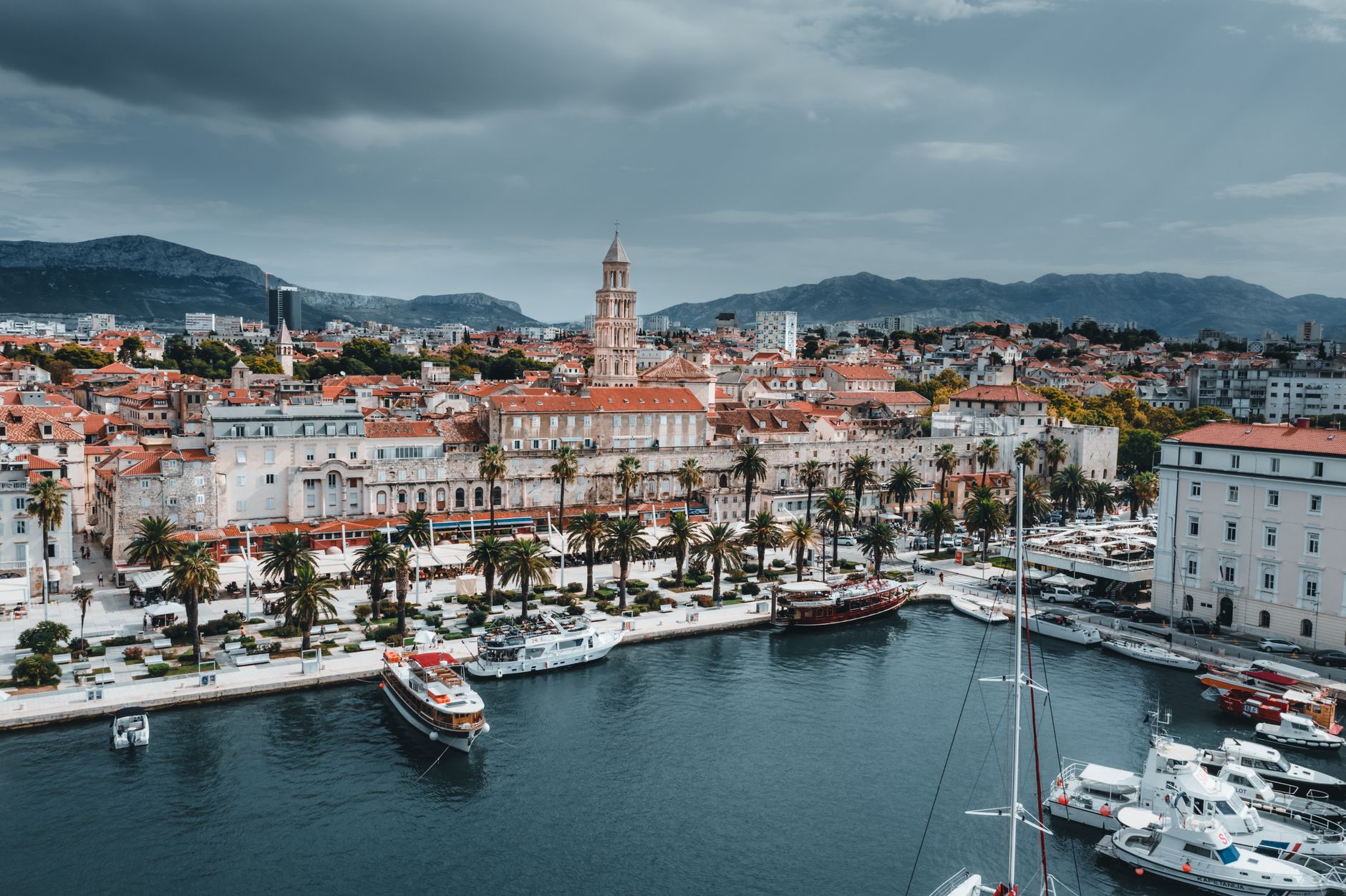
Croatia has a reputation as "the pearl of the Adriatic" — and also for draining your wallet in July. Both things are true. But the real range between a bare-bones trip and a comfortable one is more manageable than the headlines suggest.
The problem isn't Croatia. It's that most budgets floating around online mix up seasons, leave out ferry costs, and use averages that aren't useful to anyone. This article does the opposite: it takes the Split–Hvar–Dubrovnik route in July, breaks it down into three scenarios with real numbers, shows the full total, and explains what drives each figure.
The Route and Why It Works
🔗 Recommended · AviasalesSplit–Hvar–Dubrovnik is the most efficient sequence for covering the Dalmatian coast from north to south in a week. You start in Split, which has direct international flights and works as a ferry hub. Then comes Hvar, the country's most vibrant island. You finish in Dubrovnik, the most photographed destination — and, no surprise, the most expensive.
A sensible breakdown for seven days is: two nights in Split, two in Hvar, and three in Dubrovnik. That gives you real time to enjoy each place without rushing, and keeps the longest block in Dubrovnik, where arrival and departure logistics are heavier.
Ferries are the circulatory system of this route. Split to Hvar runs by catamaran — about an hour — or by conventional ferry, slower but more convenient if you're carrying large luggage. There's no consistently practical direct connection from Hvar to Dubrovnik at all hours: most travelers go back to Split and take a coastal bus. Check current schedules directly at Jadrolinija (jadrolinija.hr), the main operator, before you travel. One scheduling mistake can cost you half a day.
Croatia in July: The Context That Moves Prices
July is the absolute peak of the season in Dalmatia. Dubrovnik receives so much visitor pressure that the city formally imposed capacity limits inside the Old Town. On the busiest days, the number of simultaneous visitors within the walls can exceed 8,000. That led to a timed-entry system.
Access to the walls requires advance booking with a fixed time slot. The Dubrovnik Pass covers the walls, museums, and local transport. Check prices and availability directly at dubrovnikpass.com before you travel. In July, slots genuinely sell out.
If you show up without a wall reservation, there's a good chance you won't get in that same day. This isn't a generic warning — it's concrete logistics that affect your entire itinerary.
Accommodation prices in July run between forty and sixty percent above May or September levels, based on our estimates. If your schedule has flexibility, the first week of June or the second week of September offer the same scenery with fewer crowds and noticeably lower prices.
The Base Costs That Apply to Every Scenario
Before the scenarios, there are costs that are essentially fixed regardless of your travel style.
A round-trip international flight from Mexico or Latin America typically runs $700–$1,100 USD in July when booked three months out. Common connections go through Madrid, Frankfurt, Amsterdam, or Istanbul. Check Google Flights or Skyscanner.
The Split–Hvar catamaran costs between €8 and €12 EUR per trip in economy class, according to jadrolinija.hr. The conventional ferry is slightly cheaper if you're carrying large bags.
The most common Hvar–Dubrovnik transfer is by bus via Split. Check current schedules at autobusni-kolodvor.com before buying.

The Three Scenarios: Explicit Math
The prices below are in EUR for local costs. The approximate exchange rate at time of writing is 1 EUR ≈ 19–20 MXN. All scenarios are per person, based on a solo traveler or a couple (where accommodation is split between two).
Scenario 1: Budget (Comfortable Backpacker)
This profile sleeps in hostels with shared or budget private rooms, eats at markets and local restaurants, and uses public transport for everything.
| Item | Calculation | Estimated Total |
|---|---|---|
| Accommodation (7 nights): 2 Split + 2 Hvar + 3 Dubrovnik | 2×€35 + 2×€40 + 3×€50 = €70 + €80 + €150 | €300 |
| Meals (€25/day x 7 days) | €25 x 7 | €175 |
| Ferries and local buses | €50 (based on our estimates) | €50 |
| Entrance fees (Dubrovnik walls + 2–3 attractions) | €35 (based on our estimates) | €35 |
| Miscellaneous (souvenirs, coffee, emergencies) | €10/day x 7 | €70 |
| Total in-destination (flights not included) | €630 EUR |
With an international flight (~$800 USD based on our estimates), the approximate total per person is €630 EUR + ~$800 USD.
Scenario 2: Mid-Range (Standard Traveler)
Double room in a three-star hotel or private apartment, restaurants with a set lunch menu, public transport plus the occasional taxi or tour.
| Item | Calculation | Estimated Total |
|---|---|---|
| Accommodation (7 nights, per-person share in double): 2 Split + 2 Hvar + 3 Dubrovnik | 2×€50 + 2×€70 + 3×€75 = €465 room total / 2 = €232.5 per person | €235 |
| Meals (€45/day x 7 days) | €45 x 7 | €315 |
| Ferries, buses, and 1–2 taxis | €80 (based on our estimates) | €80 |
| Entrance fees + Dubrovnik Pass + 1 island tour | €80 (based on our estimates) | €80 |
| Miscellaneous | €15/day x 7 | €105 |
| Total in-destination (flights not included) | €815 EUR |
With an international flight (~$950 USD based on our estimates), the approximate total per person is €815 EUR + ~$950 USD.
Scenario 3: Luxury (Boutique Hotel and Premium Experiences)
Four- or five-star boutique hotel, chef-driven restaurants, private transfers, private boat excursions.
| Item | Calculation | Estimated Total |
|---|---|---|
| Accommodation (7 nights, per-person share in double): 2 Split + 2 Hvar + 3 Dubrovnik | 2×€110 + 2×€160 + 3×€190 = €1,110 room total / 2 = €555 per person | €555 |
| Meals (€90/day x 7 days) | €90 x 7 | €630 |
| Private transfers + private boat in Hvar | €250 (based on our estimates) | €250 |
| Entrance fees + Dubrovnik Pass + premium tours | €150 (based on our estimates) | €150 |
| Miscellaneous, spa, special dinners | €40/day x 7 | €280 |
| Total in-destination (flights not included) | €1,865 EUR |
With a business class or premium economy flight (from $1,500 USD based on our estimates), the approximate total per person is €1,865 EUR + from $1,500 USD.
Comparison Table: All Three Scenarios
| Profile | Accommodation/night (approx.) | Total in-destination (flights not included) | Estimated flight (CDMX, round-trip) |
|---|---|---|---|
| Budget | €30–50 EUR | ~€630 EUR | ~$800 USD |
| Mid-range | €50–75 EUR (per person in double) | ~€815 EUR | ~$950 USD |
| Luxury | €110–190 EUR (per person in double) | ~€1,865 EUR | $1,500–2,500 USD |
All figures are based on our estimates using July 2026 market prices. Verify availability and current prices before booking.
Croatia vs. Greece, Italy, and Spain in July: The Comparison That Actually Matters
This is the question most travelers have before deciding. The answer depends on three things: your accommodation budget, how much the crystal-clear water matters to you, and whether you've already been to the other destinations.
Based on our estimates, a standard double room in July averages:
- Croatia (Dubrovnik): €100–140 EUR/night at a three-star hotel
- Greece (Santorini): €130–200 EUR/night equivalent
- Italy (Amalfi Coast): €150–220 EUR/night equivalent
- Spain (Ibiza): €120–180 EUR/night equivalent
Croatia comes in fifteen to thirty percent cheaper than Greece and Spain for comparable accommodation in July, based on our estimates. The gap is even wider compared to the Amalfi Coast.
Food also tips in Croatia's favor. A set lunch with fresh fish in Split or Hvar runs around €12–18 EUR. On the Amalfi Coast or in Cinque Terre, the equivalent typically lands between €20–28 EUR.
Croatian ferries are cheaper and more frequent than Greek ones on major routes. The overall logistics are simpler than in Greece, where many connections force you through Athens.
That said, Dubrovnik in July has one of the highest concentrations of tourists per square meter anywhere in Europe. If you're after peace and quiet, lesser-known Greek islands or quieter stretches of the Spanish coast may give you better value for the experience. Croatia wins on concentrated coastal beauty and ease of movement. It loses on overcrowding inside Dubrovnik.

Practical Logistics: What You Need to Sort Before You Arrive
You don't need a car for this route. Ferries and buses cover the main transfers. Only consider renting one if you want to explore the Dalmatian interior or visit parks like Krka. In July demand is high — book at least six weeks out on rentcars.com to avoid inflated prices.
Accommodation in Hvar and Dubrovnik sells out weeks in advance. Booking two or three months ahead isn't overkill — it's standard practice.
Book your Dubrovnik Pass and wall time slot before you arrive. In July, same-day entry is not guaranteed. Check dubrovnikpass.com well in advance.
Entry Requirements: ETIAS 2026
If you're traveling from Mexico, Colombia, Argentina, or another Latin American country, you need to apply for ETIAS before entering Croatia. The system applies to travelers from Schengen visa-exempt countries and costs approximately €7 EUR per application, valid for three years or until your passport expires.
The process is entirely online and approval usually comes through quickly. Apply at least two weeks before you travel. Check updated requirements at travel.ec.europa.eu/etias, as timelines may change.
Croatia has been part of the Schengen Area since January 2023. That simplifies internal crossings but activates the ETIAS requirement for Latin American travelers.
Is Croatia Worth It in July, or Should You Wait Until September?
July has the best weather and all infrastructure running at full capacity. It also has the highest prices, the biggest crowds, and the most logistical pressure.
September — especially the first half — keeps the Adriatic warm, cuts accommodation prices by twenty-five to forty percent based on our estimates, and leaves Dubrovnik with a fraction of July's tourist volume. If your work or school schedule gives you the choice, September delivers the best value on this route.
If July is your only window, the trip is still absolutely worth it. Just go in with your reservations locked, your wall slot booked, and your budget calibrated to high-season reality.
The best trip isn't the most expensive or the cheapest — it's the best-reasoned one.
Want the numbers for your specific route?
The scenarios in this article are reference points, not personalized budgets. Your actual cost depends on your departure city, your exact dates, whether you're traveling solo or as a couple, and which activities matter to you.
If you want Osi to build out your week in Croatia with real numbers — including flights from your city, available accommodation options, and ferry logistics for your dates — reach out on Telegram. We work with data, not vague ranges.
Ready to plan your trip? Talk to Osi on Telegram and we'll work through the numbers for YOUR route.
Sources
- Jadrolinija (Croatia ferry operator): jadrolinija.hr
- Autobusni Kolodvor Zagreb (bus schedules): autobusni-kolodvor.com
- Dubrovnik Pass (walls and attractions access): dubrovnikpass.com
- ETIAS — European Commission: travel.ec.europa.eu/etias
- RentCars (car rental comparison): rentcars.com/es/
- Google Flights / Skyscanner (international flights): skyscanner.com