

Zermatt charges between €180 and €350 per night for a mid-range hotel in July. Interlaken sells out months in advance. The Tre Cime di Lavaredo in August turns into a constant parade of people, not a mountain hike. If you're putting together your Alps trip for summer 2026 and you've already seen those numbers, this article is for you.
The real question isn't whether the Alps are worth it. It's whether the overcrowded Alps are worth it when there are parallel valleys with the same geology, equivalent access, far fewer people, and noticeably lower costs. You won't find a list of pretty villages here. You'll find concrete comparisons with real numbers broken down by traveler profile, so you can decide with clear information.
Why the Alps in July–August Are a Geometry Problem
🔗 Recommended · EKTA InsuranceThe problem isn't total demand. It's that all that demand concentrates in exactly the same ten spots. Zermatt, Interlaken, Grindelwald, Hallstatt, and the Cortina circuit absorb 80% of Alpine tourism across less than 15% of the available territory.
The result is predictable: prices that double compared to low season, trails with access controls, and an experience that contradicts what most people are looking for when they picture the mountains. It's not that those places are bad. They simply pay the price of their own fame.
The logic of "everyone goes there, so it must be good" works in cities. In the Alps in July and August, it just means you pay more for less peace and quiet. Parallel valleys share the same rock, the same elevations, and trails of equal quality. The difference is the absence of crowds and the price tags that come with them.
The Crowded Destinations: What They Actually Cost
Before talking about alternatives, we need to establish the baseline with clear numbers. These are the cost ranges at the most congested destinations during July–August 2026, based on our estimates:
Zermatt, Switzerland: A mid-range hotel (three stars, double room) runs around €180–€350 per night in high season. Dinner for two at a standard restaurant comes to between €80 and €120. The Gornergrat ticket costs around CHF 94 per person (round trip). Total daily cost for two people at an intermediate spending level lands between CHF 400 and CHF 600 (roughly €420–€630).
Interlaken, Switzerland: Somewhat more accessible than Zermatt, but just as crowded. High-season accommodation: €120–€220 per night for three stars. The real problem here isn't just the price — it's availability. Booking less than four months out for July–August means risking finding nothing at all.
Cortina d'Ampezzo, Italy (Dolomites): This is the trickiest case for 2026. Cortina hosted the Winter Olympics, and while the Games are over, the renovated infrastructure and the surge in international visibility are keeping prices elevated. Based on our estimates, mid-range accommodation runs between €160 and €300 per night. If Cortina is in your plans, book as early as possible.
These aren't theoretical numbers. They're what you're going to pay if you go with the destinations everyone recommends without thinking twice.
The Alternatives: Three Zones, Different Numbers
Saas-Fee and Saas-Grund Valley, Switzerland
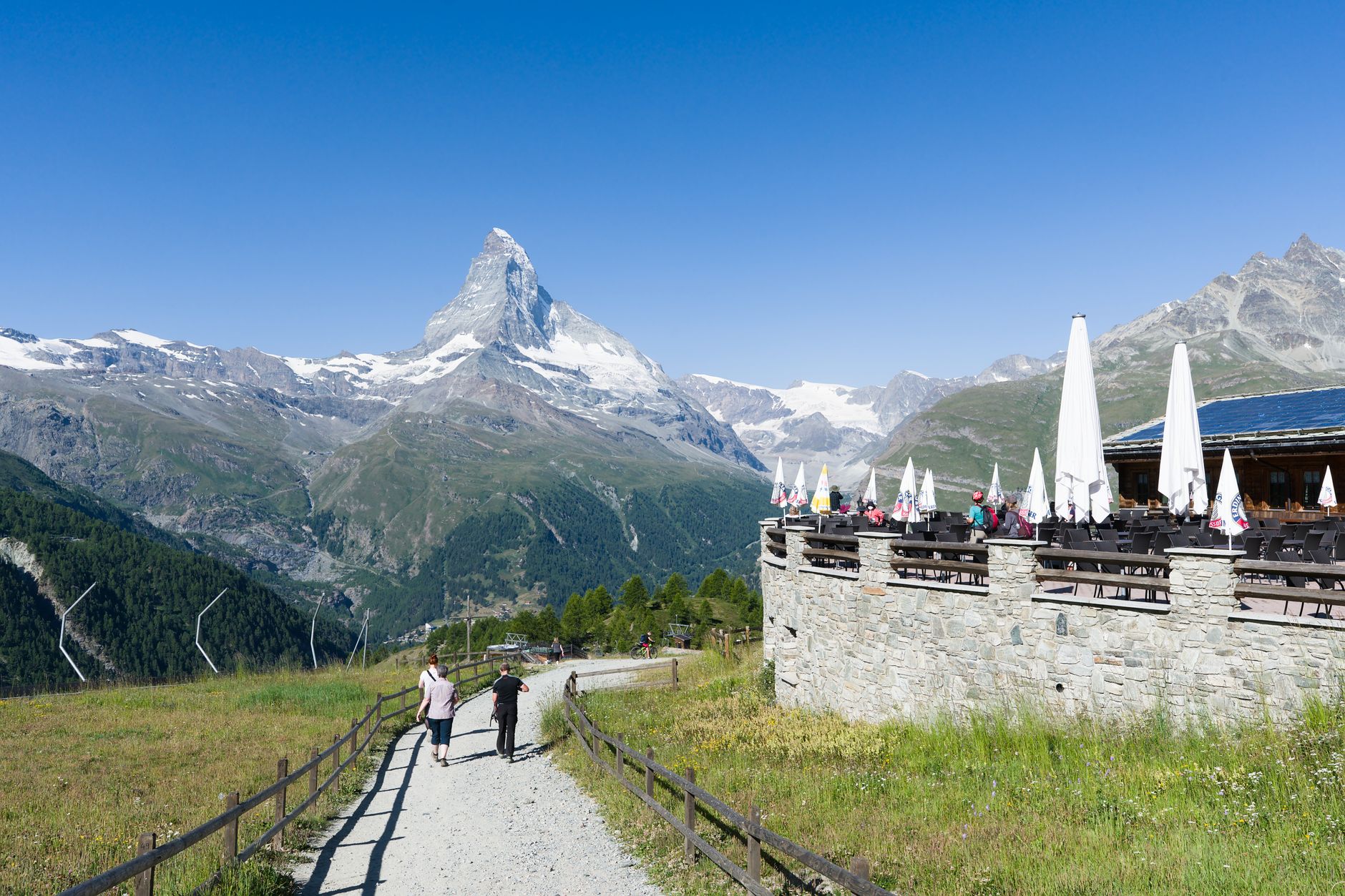
Just 30 kilometers from Zermatt, the Saas valley shares the same Monte Rosa massif with a fraction of the traffic. Saas-Fee is the car-free village. Saas-Grund, lower down, works as the budget base: frequent buses drop you at the cable cars in under fifteen minutes.
Based on our estimates, accommodation in Saas-Grund during July–August runs between €90 and €160 per night for a three-star hotel. That's a saving of between €60 and €190 per night compared to Zermatt, while keeping glaciers at a similar elevation and trails of the same quality. From there you can ride up to Mittelallalin at over 3,500 meters or hike to Lake Mattmark without the queues you'd face in Zermatt.
Swiss public transit drops you in Brig, and from there it's under ninety minutes. Perfect if you're flying into Zurich or Geneva. The difference in atmosphere is most obvious after ten in the morning: when Zermatt is already packed, you're still walking in relative calm.
Bregenzerwald Region, Austria (Vorarlberg)
Vorarlberg is Austria's westernmost state, and its tourism profile is completely different from Tyrol or Salzburg. The Bregenzerwald stands out for its contemporary rural architecture integrated into the landscape, excellent local cheeses, and valley hiking without massive infrastructure.
The daily cost at an intermediate level for this region, based on our estimates, falls between €160 and €280 per person, including accommodation, meals, and activities. Fewer crowded gondolas, more living local culture, and trails you almost always have to yourself.
You can base yourself in Schwarzenberg or Bezau, hike the Mellau waterfall trail, or head up to the Walserkamm. Connections from Zurich take around two hours to Bregenz; from Munich, under two and a half hours. Check schedules at oebb.at before building your itinerary. The experience feels more like visiting a living community than touring a mountain theme park.
Dolomites Without Cortina: Val di Funes and Valle Aurina
The Dolomites are not just Cortina and the Tre Cime. Val di Funes, north of Bolzano, offers the same limestone towers and the iconic postcard view of Santa Maddalena against the Odle group, but with a fraction of the visitors.
Valle Aurina (Ahrntal), further north, is the longest valley in the Italian Alps and ends at glaciers. Virtually unknown to Latin American tourism, and the prices reflect that.
Based on our estimates, accommodation in these areas during July–August runs between €80 and €150 per night at a Gasthof or family guesthouse, with three-star hotels ranging from €120 to €200. That's a discount of between 30% and 50% compared to Cortina.
In Val di Funes, walk the Adolf Munkel Weg for crowd-free views. In Valle Aurina, head up toward the Venediger peaks. You can get there easily from Innsbruck or Munich in two to three hours; the rail hub is Brunico. The concrete advantage: even in August you can find silence on routes that would be impossible in Cortina.
Comparison Table: Crowded Destinations vs. Alternatives
| Destination | Profile | Accommodation/night (€) | Estimated daily cost/person | July–August crowding | Estimated savings vs. crowded |
|---|---|---|---|---|---|
| Zermatt, CH | Intermediate | 180–350 | 210–315 | Very high | — |
| Interlaken, CH | Intermediate | 120–220 | 150–250 | Very high | — |
| Cortina d'Ampezzo, IT | Intermediate | 160–300 | 180–270 | High (Olympics effect) | — |
| Saas-Grund, CH | Intermediate | 90–160 | 130–200 | Moderate | 40% |
| Bregenzerwald, AT | Intermediate | 100–180 | 160–280 | Low | 35–45% |
| Val di Funes, IT | Intermediate | 80–150 | 120–190 | Low–moderate | 40% |
| Valle Aurina, IT | Intermediate | 80–150 | 110–180 | Low | 45–50% |
All figures in this table are based on our estimates for July–August 2026. Verify availability and current prices before booking.
2026 Logistics: ETIAS and EES
Two regulatory changes affect Latin American travelers in Europe for 2026. Worth mentioning, without overcomplicating it.
ETIAS (European Travel Information and Authorization System): already up and running. For travelers from Mexico, Colombia, Argentina, and other Latin American countries who visit Europe without a Schengen visa, getting the online authorization before your trip is mandatory. It costs €7 and you apply at travel.ec.europa.eu. Do it several weeks in advance.
EES (Entry/Exit System): biometric registration of entries and exits from the Schengen area. It doesn't change your eligibility, but it adds a few minutes at immigration the first time. Internal crossings between Switzerland, Austria, and Italy don't trigger additional registrations, because Switzerland is part of the Schengen area.
The Flights Factor: Getting to the Alps from Latin America
The most useful entry hubs are Zurich, Geneva, Munich, and Milan. From CDMX, flight ranges for July–August 2026 run from $550 to $1,400 USD depending on how far in advance you book and the airline. Check ITA Matrix or the airlines directly, because prices are still moving.
Your choice of hub has a direct impact on your total budget:
- Munich is the cheapest gateway to Austrian Tyrol, the Bregenzerwald, and the northern Dolomites. From there, Valle Aurina is under three hours away.
- Zurich connects perfectly with Saas-Grund and the Bregenzerwald. Excellent train connections.
- Milan (Malpensa) works for the southern Dolomites or for combining with Lake Como.
- Geneva is the best option for the French Alps, which we don't cover here but also have some great quiet alternatives.
Choose your airport based first on which valley you'll be sleeping in most nights. That one decision saves more money than almost anything else in your trip.
Osi's Take: Three Profiles, One Recommendation Each
Profile 1: You want the Swiss Alps but not Zermatt prices.
Go straight to Saas-Grund. Same mountain range, same glaciers, same elevation, and 40% less on accommodation. The Monte Rosa looks the same from both valleys. If you're set on Zermatt, book at least five months out and accept the prices without surprise.
Profile 2: You prefer Austria for the cost and want something different from Hallstatt or Innsbruck.
The Bregenzerwald is your answer. The best balance of scenery, local food, and crowd-free trails. Costs are manageable (€160–€280 per person per day at an intermediate level), access from Munich or Zurich is straightforward, and the trails are almost always yours alone.
Profile 3: The Dolomites are your goal, but Cortina feels too expensive or too crowded.
Val di Funes or Valle Aurina solve it. Dolomite tower scenery, 30% to 50% cheaper, and far fewer people. Valle Aurina in particular is virtually unknown to Latin American tourism. A real advantage in August.
If you've already locked in Cortina, it's not a fatal mistake. But next time, consider these options. The Olympic price effect is real and it's not coming down anytime soon.
What the "Pretty Villages" Articles Don't Tell You
Most articles end up as lists with photos. They leave you with more options and zero criteria for choosing between them.
The criteria that actually work are numerical and practical. Identify your arrival hub, calculate internal transport, add estimated accommodation for your profile, factor in meals and activities, and compare the total against the crowded destination you had in mind.
If the difference is under 20%, it might not be worth rethinking your plans. When it exceeds 35% — as it does in the cases we looked at — the conversation changes completely.
A concrete example: seven nights in Zermatt for two people in a mid-range hotel easily tops €2,100 in accommodation alone. In Saas-Grund, you're looking at around €980. That difference of over a thousand euros lets you extend the trip, eat better, or hire a local guide for a couple of days. Concrete numbers, not feelings.
The best trip isn't the most expensive or the cheapest — it's the best reasoned.
Want us to run the numbers for your specific route? Tell us your departure hub, your travel style (budget, intermediate, or comfortable), and how many days you have. Talk to Osi on Telegram and we'll help you work out the numbers for your itinerary.
Sources and references:
1. Alpine accommodation price comparison: estimates based on data from Booking.com, Hotels.com, and local platforms for July–August 2026 season
2. ETIAS — European Travel Information and Authorization System: travel.ec.europa.eu
3. ÖBB (Austrian Federal Railways) — schedules and fares: oebb.at
4. SBB (Swiss Federal Railways) — internal connections: sbb.ch
5. Information on the Cortina 2026 Winter Olympics and its effect on local prices: cortina2026.com and analysis from accommodation platforms
6. Regional tourism official sites: saas-fee.ch, bregenzerwald.at, suedtirol.info, valdifunes.it
7. Latin America–Europe flight ranges for 2026: cross-referenced with updated data from Google Flights and ITA Matrix